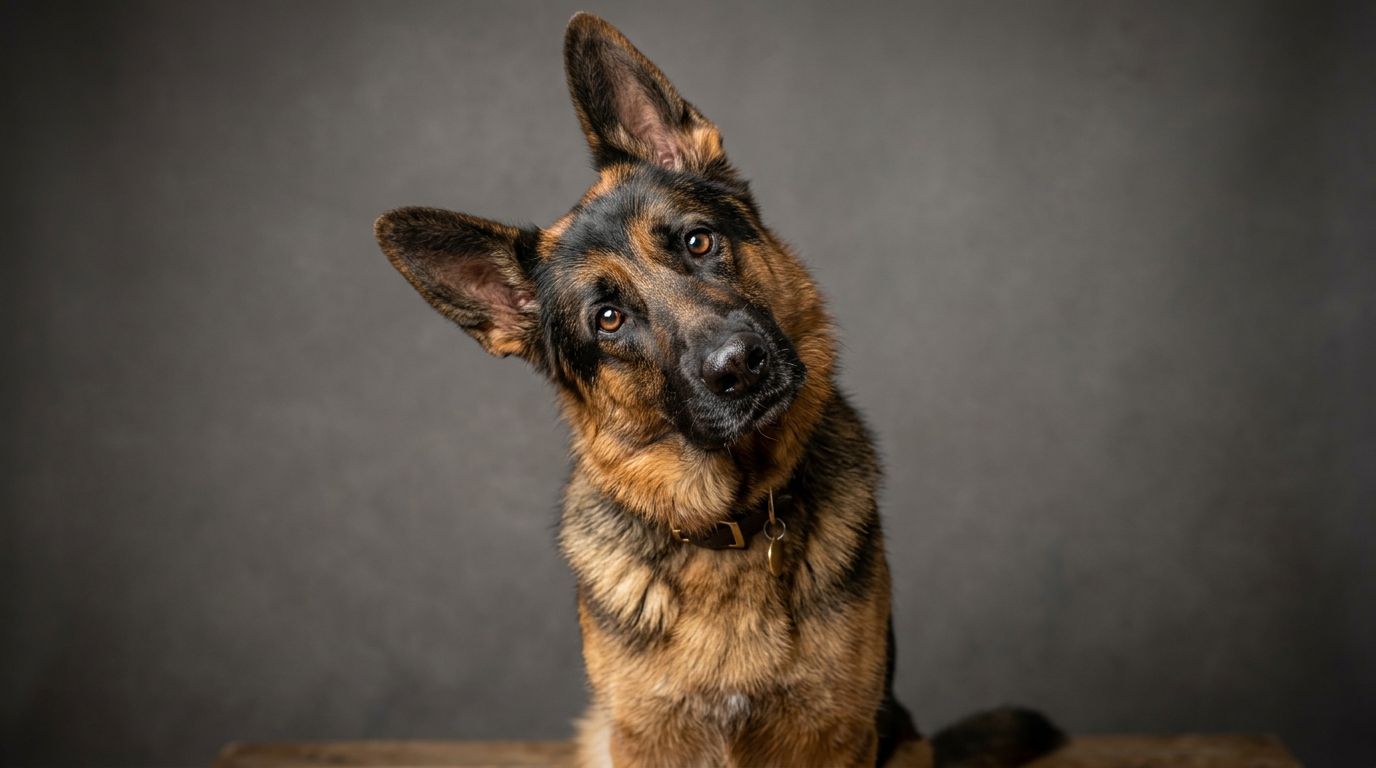
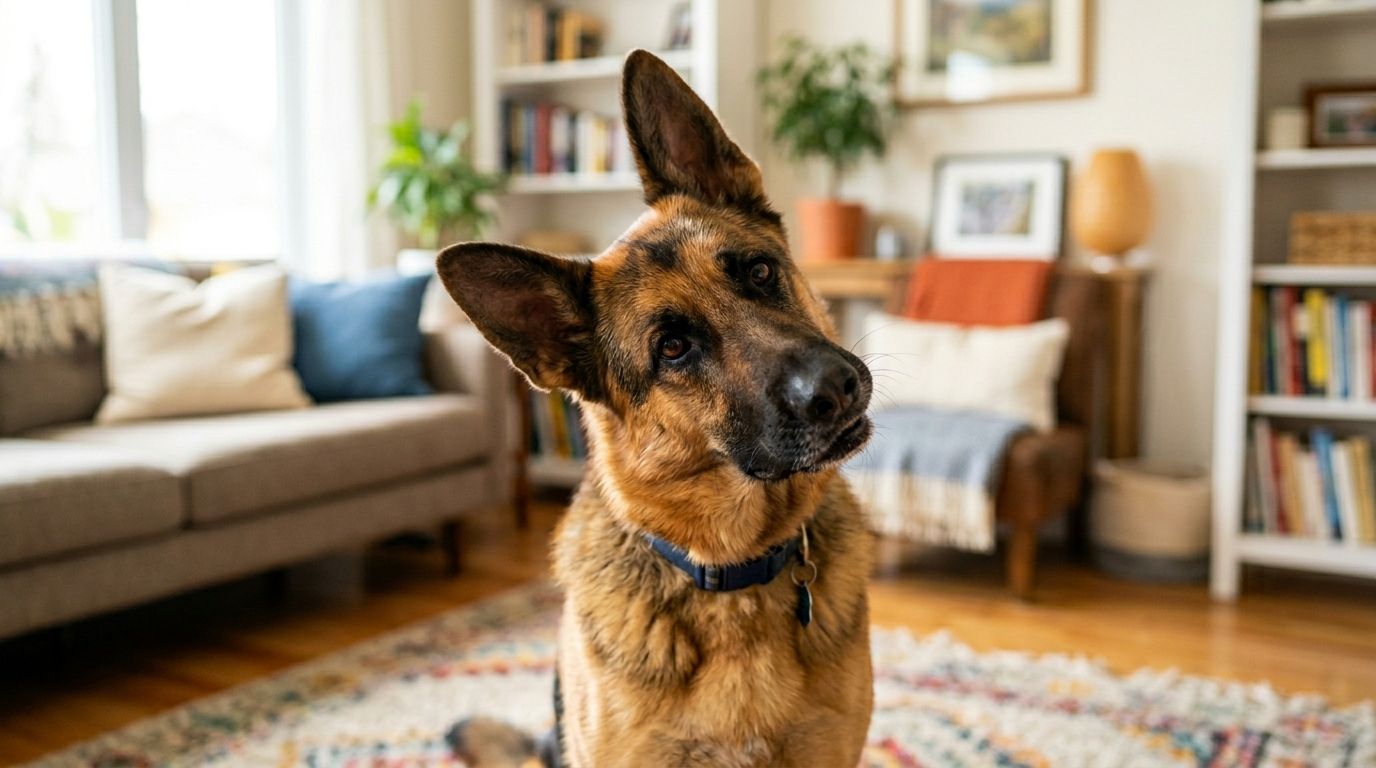
It's the pose that melts hearts everywhere: your German Shepherd looks up at you, cocks their head to the side, ears perked, eyes wide - and you instantly forget everything you were doing.
The German Shepherd head tilt is one of the most iconic and endearing behaviors in the dog world. But why do German Shepherds tilt their heads? Is it just cuteness, or is something more complex happening?
Turns out, it's a combination of biology, intelligence, and emotional bonding - and German Shepherds do it more than most breeds.
The Science of the Head Tilt
Sound Localization
The primary reason dogs tilt their heads is to better locate and process sounds. Dogs have incredibly sensitive hearing - they can detect frequencies up to 65,000 Hz, compared to our 20,000 Hz - but their brains need help pinpointing exactly where sounds are coming from.
When your German Shepherd tilts their head, they're adjusting the position of their ear canals to triangulate the source of a sound. This slight angle change helps their brain calculate:
- The direction of the sound
- The distance from the source
- The pitch and tone more accurately
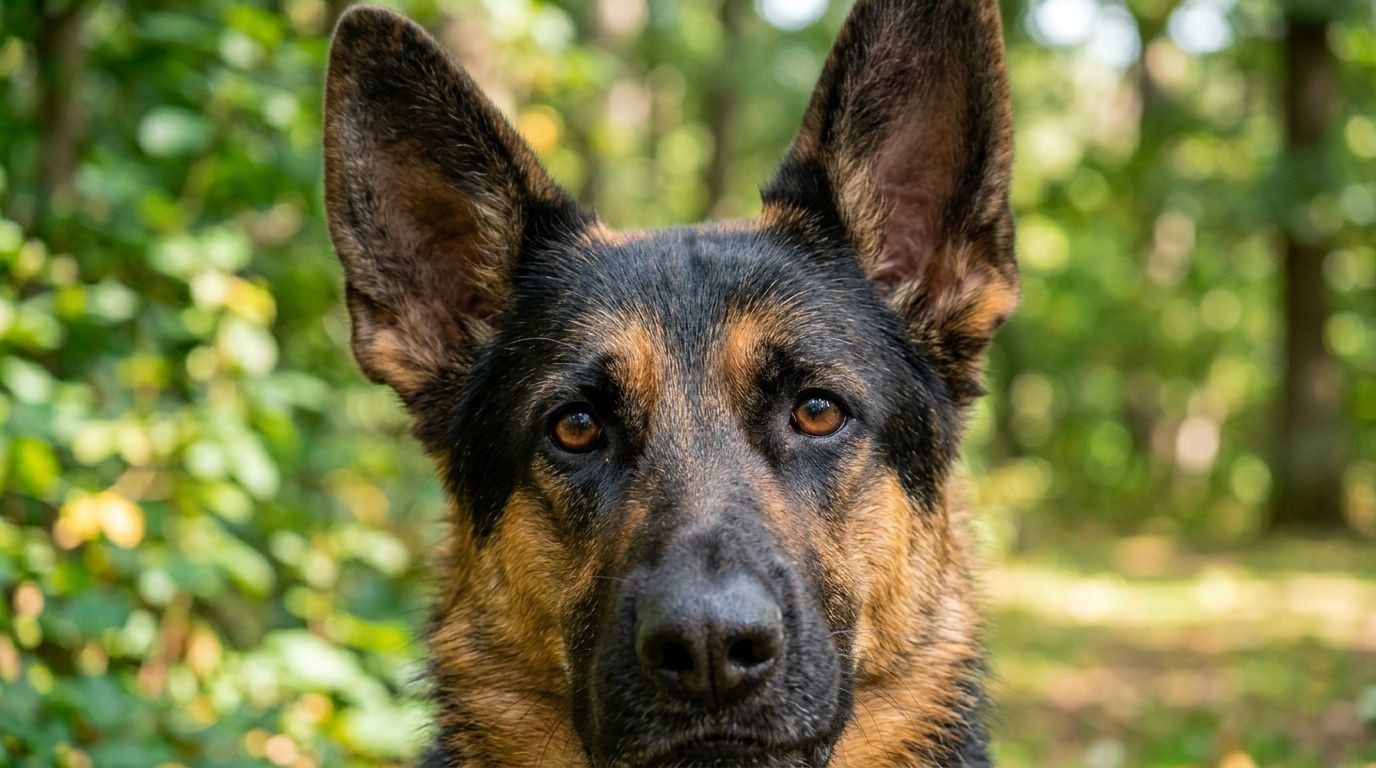
German Shepherds have large, upright ears - and the way those ears develop from floppy puppy ears to the iconic upright position is fascinating - that already function like satellite dishes. The head tilt fine-tunes this natural advantage.
Muzzle Obstruction Theory
Research from Dr. Stanley Coren, a canine psychologist, suggests that dogs with longer muzzles tilt their heads more frequently because their snout partially blocks their view of the speaker's face.
German Shepherds have a pronounced muzzle compared to flat-faced breeds like Pugs or Bulldogs. When they tilt their head, they're repositioning to see your full facial expression - including your mouth, which they watch closely for visual cues.
This theory is supported by the observation that brachycephalic (flat-faced) breeds tilt their heads less frequently than long-snouted breeds like GSDs.
6 Reasons Your German Shepherd Tilts Their Head
1. They're Trying to Understand You
German Shepherds are one of the most attentive breeds when it comes to human communication. They don't just hear your words - they analyze your tone, watch your facial expressions, and read your body language to extract meaning from everything you say.
The head tilt often appears when you:
- Say specific words they recognize ("walk," "treat," "car")
- Use an unusual tone of voice
- Ask them a question (yes, they can tell the difference between a statement and a question)
- Make an unexpected sound
They're essentially saying, "Hold on, I'm processing that."
2. They Hear Something You Can't
Your German Shepherd can hear sounds that are completely inaudible to you. When they suddenly tilt their head at seemingly nothing, they might be:
- Hearing a distant siren you can't detect yet
- Picking up on a high-frequency animal sound
- Detecting the subtle hum of electronics
- Hearing a neighbor's dog or cat from blocks away
If your GSD tilts their head and then looks toward the door or window, they're almost certainly hearing something outside your range.
3. They've Learned It Gets a Positive Reaction
Here's the honest truth: your German Shepherd has noticed that head tilting makes you happy.
When they tilt their head and you respond with "Awww!" or give them a treat or attention, they file that information away. German Shepherds are master observers of human behavior, and they quickly learn that:
- Head tilt → human smiles → attention/treats → repeat
This operant conditioning means the behavior becomes more frequent over time. Your GSD isn't being manipulative - they're just smart enough to know what works.
4. Empathy and Emotional Connection
A 2021 study published in Animal Cognition found that "gifted" dogs (those who learn words quickly) tilt their heads more frequently than average dogs. The researchers suggested that the head tilt is associated with processing meaningful stimuli and may indicate heightened mental engagement.
German Shepherds, ranked as the 3rd most intelligent breed, naturally fall into this "gifted" category. Their head tilts may be a visible sign of their brain actively working to understand and empathize with their owner.
When you speak to your GSD and they tilt their head, they're genuinely trying to understand not just what you're saying, but how you're feeling.
5. High-Frequency Sound Detection
German Shepherds have exceptional hearing, particularly in the high-frequency range. Certain sounds trigger head tilts more than others:
| Sound Type | Head Tilt Likelihood |
|---|---|
| High-pitched human voice ("Who's a good boy?") | Very High |
| Squeaky toys | High |
| Other dogs barking (distant) | High |
| Normal conversation | Low |
| Deep bass sounds | Low |
The head tilt is most often triggered by sounds in the higher-frequency ranges, which is why baby talk and squeaky tones make your GSD tilt their head like clockwork.
6. Vestibular Assessment
In rare cases, frequent or persistent head tilting can indicate a vestibular issue - a problem with the inner ear that affects balance. This is different from the occasional cute head tilt.
Warning signs of vestibular disease:
- Head is constantly tilted to one side (not just during interaction)
- Loss of balance or stumbling
- Rapid eye movement (nystagmus)
- Nausea or vomiting
- Circling in one direction
If your German Shepherd's head tilt seems constant, involuntary, or is accompanied by these symptoms, consult your veterinarian immediately. Vestibular disease is treatable but requires prompt attention.
Why German Shepherds Tilt Their Heads More Than Other Breeds
Not all breeds are equal head-tilters. German Shepherds rank among the top for several reasons:
- Large, upright ears - More surface area to adjust for sound localization
- Long muzzle - Greater need to reposition to see the full face
- High intelligence - More active processing of human communication
- Strong human bond - More attentive to owner's words and emotions
- Vocal breed - Already naturally attuned to sound nuances
Breeds like Huskies, Golden Retrievers, and Border Collies also tilt frequently, while Bulldogs, Pugs, and Basset Hounds tend to do it less. The physical differences between GSD coat types and breed variations may also play a role in how frequently different GSDs tilt.
Should You Encourage Head Tilting?
Absolutely - as long as it's voluntary and occasional. It's a sign of:
- Engagement with you
- Active listening
- Emotional intelligence
- Trust and comfort
The only time to be concerned is if the tilt becomes persistent and involuntary, which could indicate a medical issue.